

◆ Water and Food Security (WaFoS) Programme
◆ Farmers’ Clubs and Farmers’ Joint Liability Groups
◆ Rainwater Harvesting and Groundwater recharging
◆ Local Governance of Water Resources
◆ Youth Eco-Clubs
◆ WaSH Clubs for Children
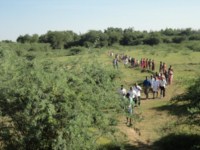

☛ Community Water Walk
☛ Village Vision Building
☛ Eri thiruvizha
☛ Water Budgeting
☛ Decision making- at the Gramasabha
☛ Thrift and credit among farmers, for financial inclusion
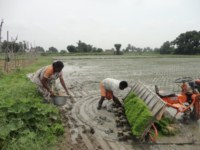
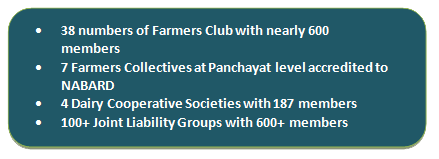
PROGRAMMES IN NUTSHELL : With Farmers 35 numbers of Farmers Club, 7 Farmers Collectives, 4 Dairy Cooperative Societies
Promote self-help
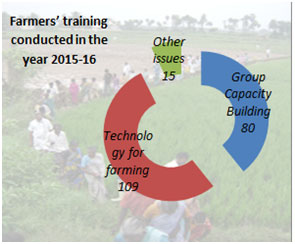
Disseminate techniCal know-how and do-how
Thrift and credit among the group
To encourage good financial practices (including repayment culture)
Reducing Water consumption,
Increasing soil fertility, and thereby
Increasing productivity
To reduce drudgery
To cope up with labour shortage
Post harvesting practices
To promote value addition
To enable delayed marketing
To create more storage facilities
Short term credit assistance for farming related expenditures
Bank linkages
Leadership Training
To organize / conduct other programmes like cancer / eye screening / dental treatment camps, monitoring the SLCs, sanitation promotion
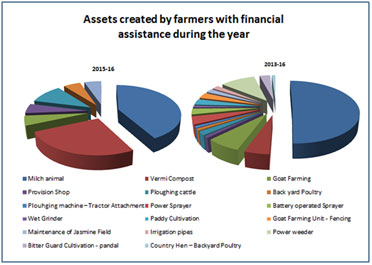
| During April 2013- March 2016 |
| Total No of Beneficiaries & Groups 111/14 |
| Total Credit Assistance INR 19,90,100 |
| Repayment Rate 96% |
☛ Technology adoption for sustainable and profitable farming
☛ SRI in paddy and micro irrigation systems for horticulture crops to reduce water consumption
☛ Increased awareness on soil health, and need for natural farming
☛ Integrated pest management and natural pest control methods
☛ Farm mechanisation to reduce drudgery and to cope up with labour shortage
☛ Post-harvest interventions to reduce wastage and loss of produces and value addition
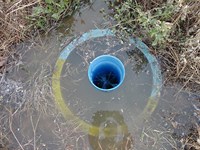
☛ Adoption of rainwater harvesting to augment ground water storage through ground water recharge shaft
☛ Increase in self-help among farmers through groups
☛ Thrift and credit within the group
☛ Reduced dependency on local money lenders and relieved from exorbitant interests paid
☛ Adoption of good financial practices including credit repayment
☛ Financial support in the form of short term credit assistance for farming and bank linkages
☛ Leadership training, to sustain the programme impacts and residuals; to take up locally relevant development programme
☛ Ground water Recharge shaft:Standalone, conversion of old defunct borewells, add-on to functioning borewells
☛ Recharge Trench
☛ Conversion of Old unused open wells
15000 + households and 75000 + population 30 Panchayats (100+ villages) of Ellapuram, Poondi, Thiruvallur, and Sholavaram Blocks in Thiruvallur District, located within 20 to 50 kms from the Chennai City limit (http://tinyurl.com/mxquoxg)
State Government Departments (Food &Water related)
Central Government Institutions (RSF&, CCBF)
NABARD
SWISS India Trust, Chennai
Live Energies Foundation, Chennai
CEC, Chennai